
Understanding Your Autism
If you've spent your whole life feeling like you don't quite fit, like you're reading the social world wrong, like you have to work ten times harder than everyone else to keep up, you're not alone. Maybe you're an adult woman who just got diagnosed as autistic and suddenly everything makes sense. Maybe you've always known something was different but didn't have the language for it. Maybe you're so good at masking that no one sees how much energy it takes. Maybe you're burning out because what used to work no longer does. Autism isn't a deficit. It's how your brain and nervous system work. And understanding it can change everything.
What Does It Mean to be Autistic?
Autism is a neurological difference in how you process information, communicate, perceive sensory input, and interact with the world. It's not something you caught. It's not something that happened to you. It's how your brain is wired. Autistic people perceive and process the world differently. You might notice patterns others miss. You might have intense, deep interests that you can focus on for hours. You might experience sensory input more intensely. You might struggle with unwritten social rules that seem obvious to others. You might process communication differently, either taking words literally or missing subtle social cues.
Autism in women often looks very different than autism in men. Women with autism are often missed because they're good at masking. You learned early to watch other people and copy their behavior. You study social rules like a foreign language and practice them until they feel automatic. No one sees the effort. No one sees that you're constantly translating, constantly monitoring, constantly adjusting. You appear fine. You appear social. You appear to understand the unwritten rules. But inside, you're exhausted from the work of being neurotypical.
Autistic people also have different sensory processing. You might be sensitive to certain sounds, lights, textures, or smells. You might need to wear only certain types of clothing. You might struggle in busy, overwhelming environments. You might need quiet time to recover from social interaction. You might have a strong need for routine and predictability. Changes to routine can feel destabilizing even when they're small. You might have intense emotional responses to perceived injustice or unfairness. Your sense of justice might be one of your deepest drives.
Why It Takes So Long to Recognize Autism
Autism screening tools were designed based on how autism looks in boys and men. You might have answered 'no' to screening questions because they didn't match your experience. You might have been told you can't be autistic because you're verbal, or because you have friends, or because you seem fine. You might have been told you have anxiety when actually your anxiety is about unpredictability and sensory overwhelm. You might have been told you're rude or blunt when you were just being direct and honest. You might have been told you're too sensitive when you were just responding to sensory input others couldn't perceive.
And because you've masked so well, no one saw the struggle. You looked fine on the outside. You navigated social situations, held jobs, maintained relationships. No one saw the hours spent planning social interactions, the exhaustion from maintaining the mask, the sensory pain you endured to blend in, or the way you crashed when you couldn't sustain it anymore.
Grief and the Path Forward
Understanding that you're autistic brings relief for some people. Finally, a name. Finally, an explanation. But it also brings grief. Grief for your younger self who was told she was too sensitive, too literal, too rigid, or not social enough. Grief for the way you were treated as difficult or rude when you were just being authentic. Grief for the relationships that didn't work out because your communication style was misunderstood. Grief for the career paths that became unsustainable because the sensory environment or social demands were too high. Grief for the exhaustion of masking for so long. Grief for wondering what your life could have looked like if you'd been allowed to be yourself from the beginning.
This grief is real and it's important. You get to feel angry that this wasn't named. You get to feel sad about what was lost. You get to feel relief and confusion at the same time. All of those feelings are valid.
At the same time, understanding your autism opens up a different path forward. It's not about fixing yourself or becoming less autistic. It's about understanding how your brain works and building a life that honors that. It's about recognizing that your loyalty is a superpower. Your justice-oriented mind is a gift. Your ability to notice details and patterns is valuable. Your authenticity, once you stop masking, is beautiful. You're not broken. You're autistic.
Whether you're formally diagnosed or still exploring, this understanding changes things. It shifts the blame from yourself to the mismatch between your needs and the neurotypical world. And from there, you can actually make changes.

How ADHD Shows Up
Autism shows up differently for everyone, but common patterns include communication differences. You might be direct and literal, sometimes saying things that land wrong without meaning to. You might struggle to understand what someone really means beneath their words. You might miss subtle social cues like facial expressions or tone of voice. You might prefer written communication where you can take time to process. You might struggle with small talk or unstructured social situations. You might be very comfortable talking about topics you know deeply but struggle in casual conversation.
You might experience sensory sensitivities. Certain sounds, lights, textures, smells, or tastes are unbearable. You might wear only certain types of clothing. You might struggle in busy, chaotic environments. You might need a lot of quiet time to recover after social interaction. You might have difficulty with transitions or changes to your routine, even small ones. Changes feel destabilizing and can trigger anxiety or overwhelm.
You might have a strong need for routine and predictability. You might struggle with flexibility or spontaneity. You might have intense interests that you can focus on deeply. You might organize information in patterns and systems. You might notice details others miss. You might have a strong sense of justice and fairness, and injustice can feel deeply painful.
You might experience masking burnout. This is different from regular burnout. It's the exhaustion of constantly translating, monitoring, and adjusting to be acceptable. Masking burnout can look like shutdown, where you stop functioning. It can look like meltdowns, where you're overwhelmed and can't regulate. It can look like intense fatigue where even basic tasks feel impossible. It can look like dissociation or disconnection from yourself.
Many autistic people also experience anxiety, depression, or trauma. Sometimes these are separate struggles. Sometimes they're directly connected to a lifetime of not fitting in, of masking, of being misunderstood. All of this can be true at once.
The Strengths & Superpowers:
Autism isn't all challenges. There are genuine strengths that come with how your brain is wired. Many autistic people notice patterns and details others miss. You see the connections. You organize information systematically. You think in logical, organized ways. You're often good at learning rules and systems. You have strong focus and can dive deeply into topics you care about.
Many autistic people have intense loyalty. You're true to the people you care about. You're reliable and dependable. You value honesty and authenticity. You're not comfortable with social games or pretense. You say what you mean and you expect others to do the same. Once you stop masking, your authenticity is a gift.
Many autistic people have a deep sense of justice. You feel strongly about fairness and what's right. You're passionate about fixing things that are broken. You're willing to speak up about injustice even when it's uncomfortable. This can make you a powerful advocate, both for yourself and for others.
Many autistic people have rich inner worlds. You might be creative in unique ways. You might have strong special interests that bring you joy and focus. You might have excellent memory for details that matter to you. You might be thoughtful and reflective. You might perceive beauty or meaning in things others overlook.
These aren't secondary benefits that come with the struggle. These are real strengths. The goal isn't to erase your autism or become neurotypical. The goal is to understand your whole self. To recognize where you struggle and where you shine. To build a life that lets you be authentically you.

How I Work with You
This work is about helping you understand your autism and building a life that actually works for how your brain functions. If you're newly diagnosed, we explore what autism means for you and your life. If you've known for a while, we work on the grief and the adjustments. We talk about unmasking, about burnout, about what's changed and why what used to work no longer does. We problem-solve together around sensory sensitivities, communication, routine changes, social situations, and work.
I use evidence-informed approaches combined with autistic-informed practices. This means I'm not trying to make you more neurotypical or teach you to mask better. I'm helping you understand how you work and building strategies that honor your neurology. We talk about what unmasking might look like and what you actually want in your life.
A big part of this work is reconnecting with and reparenting your inner child. You were likely told you were too sensitive, too rigid, too literal, or not social enough. Your younger self internalized shame about how she communicates and perceives the world. We work together to undo that and teach your inner child that she's not broken. That she's autistic. That her way of being in the world is valid.
We work on getting you back into your body. Many autistic people have become disconnected from their bodies because of masking and sensory overwhelm. We use movement, yoga, and sensory awareness to help you reconnect. We work on interoception, learning to recognize and understand what your body is telling you. This helps you know when you're getting overwhelmed before you hit shutdown or meltdown. We use somatic practices to help your nervous system feel safer.
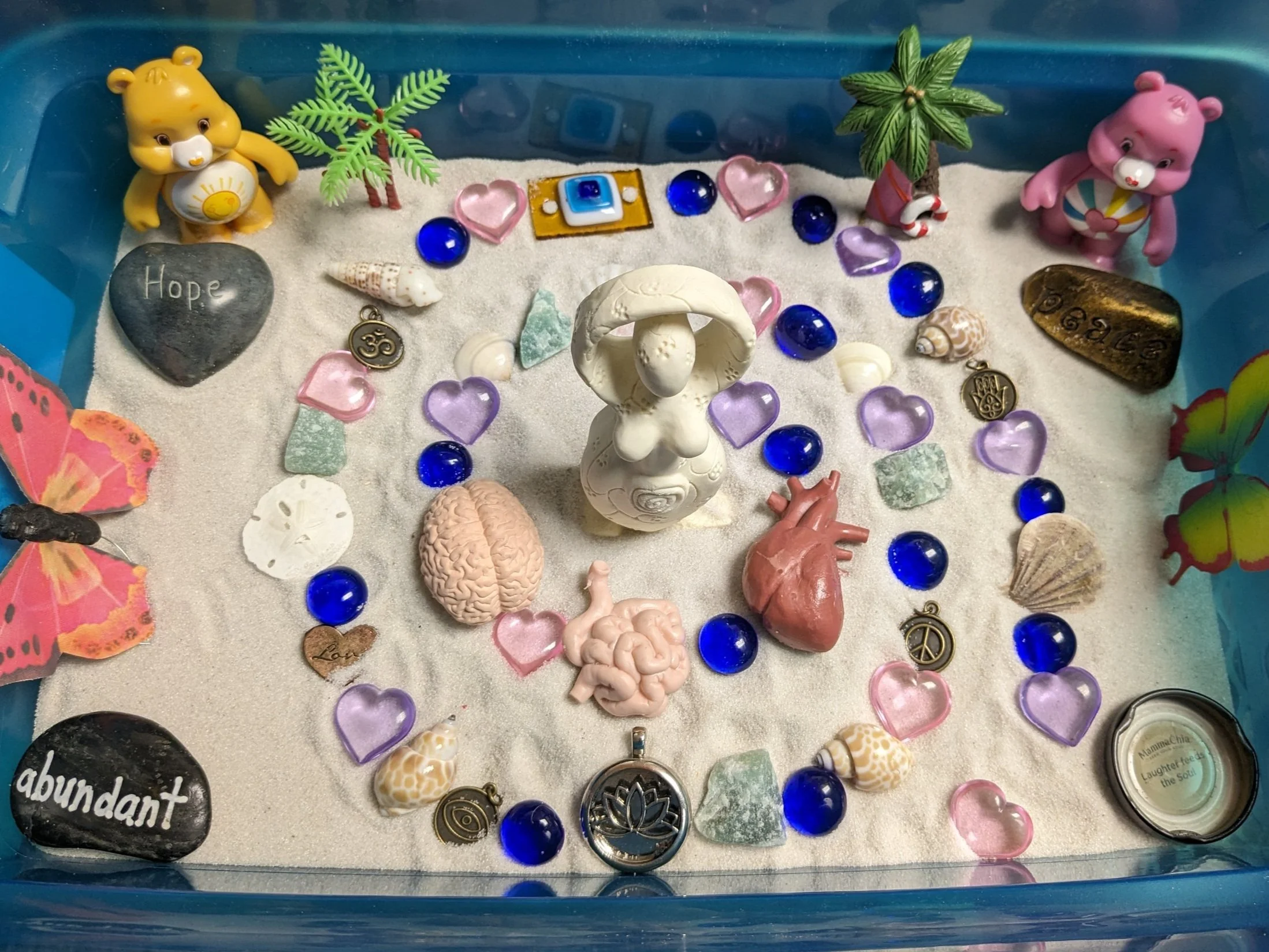
I also use sandtray therapy when helpful. When you're overwhelmed, when words don't work, when you need to externalize what's happening inside, the sandtray offers a different way of processing. You can build, create, arrange. You can see your internal world outside of you. This can be especially powerful for autistic clients.
We explore your pattern recognition and special interests alongside your communication challenges. We work on nervous system regulation, boundary-setting, communication skills, and self-compassion. If you're carrying anxiety or depression alongside your autism, we address that too. Sometimes what looks like anxiety is actually sensory overwhelm or social exhaustion. Sometimes it's both. We work to untangle what's what so you can get the support you actually need.
This is also about permission. Permission to be yourself. Permission to need quiet time. Permission to say no to social situations that drain you. Permission to build a life around your authentic self, not the mask you've been wearing.
You're Not Broken.
Your Brain Just Works Differently.
If this resonates with you, whether you're newly diagnosed, exploring autism, or wondering if autism might explain some of your struggles, let's talk. I offer a free consultation to explore your experience and see if we're a good fit.