
Understanding Your ADHD
If you were told you were anxious, disorganized, scattered, or not trying hard enough when what was really happening is that your brain has ADHD, you're not alone. Maybe you're an adult woman who just got diagnosed and suddenly everything makes sense. Maybe you've suspected it for years but never fit the stereotype. Maybe you were so good at holding it together that no one saw the effort it took. Maybe you've managed ADHD your whole life without knowing that's what it was, and now something has changed and you're burning out. ADHD isn't a character flaw. It's how your brain works. And understanding it can change everything.
What Does It Mean to Have ADHD?
ADHD stands for Attention Deficit Hyperactivity Disorder, but that name is misleading. It's not about deficit attention. It's about attention that works differently. Your brain has a different relationship with focus, executive function, impulse control, and emotional regulation. You might hyperfocus intensely on things you're interested in and struggle to focus on things you're not. You might have racing thoughts that make it hard to sleep. You might struggle with time management, prioritization, and starting tasks even when you know they're important. You might feel restless and need to move, or you might feel the restlessness internally in your mind.
ADHD in women often looks very different than ADHD in men. Women with ADHD are often missed because they don't match the hyperactive stereotype. You might not bounce around. Instead, you might internalize the restlessness as anxiety. You might have learned to mask so well that you appear organized and focused when inside you're struggling. You might be a perfectionist trying to compensate for the executive function challenges. You might seem fine in structured environments and then fall apart at home because you've used all your capacity at work.
ADHD also affects emotional regulation. You might feel emotions intensely. You might have difficulty managing anger or frustration. You might feel rejection deeply, even when it's perceived. You might struggle with motivation, especially for things you don't find interesting, even when they matter. Your dopamine regulation is different, which is why boring tasks feel nearly impossible but interesting ones pull you in completely.

Why It Takes So Long to Recognize ADHD
ADHD screening tools were designed based on how ADHD looks in boys and men. They ask about hyperactivity. You weren't hyperactive. They ask about trouble sitting still. You learned to sit still. They don't ask about the internal restlessness, the racing thoughts at night, the intense hyperfocus, the way you lose track of time, or the emotional dysregulation you experience. They don't ask about the way you've organized your entire life around managing your ADHD without knowing that's what it is. Only buying clothes without tags. Setting phone reminders for everything. Breaking big tasks into tiny steps. Avoiding certain environments because they're too stimulating. Using rigid routines because change feels chaotic.
You might have answered 'no' to screening questions because they didn't match your experience. You might have been told you can't have ADHD because you're doing well in school or work, not realizing that success takes you twice as much effort as your neurotypical peers. You might have been told it's anxiety, when actually anxiety is a symptom of unmanaged ADHD. You might have been told you just need to try harder or be more organized, when actually your brain doesn't work that way no matter how hard you try.
And because you've masked so well, no one saw the struggle. You looked fine on the outside. You got the grades, held the job, maintained the relationships. No one saw the hours you spent organizing, the energy it took to focus, the shame you felt about forgetting important things, or the way you crashed when you couldn't sustain the effort anymore.
Grief and the Path Forward
Understanding that you have ADHD brings relief for some people. Finally, a name. Finally, an explanation. But it also brings grief. Grief for your younger self who trying twice as hard as everyone else yet still struggling. Grief for the way you were treated as lazy, scattered, or disorganized when your brain just works differently. Grief for the relationships that didn't work out because your time blindness or forgetfulness was misunderstood. Grief for the career paths that became unsustainable because the executive function demands were too high. Grief for wondering what your life could have looked like if someone had recognized this and supported you differently.
This grief is real and it's important. You get to feel angry that this wasn't named. You get to feel sad about what was lost. You get to feel relief and confusion at the same time. All of those feelings are valid.
At the same time, understanding your ADHD opens up a different path forward. It's not about fixing yourself. It's about understanding how your brain works and building a life that works with it, not against it. It's about recognizing that your hyperfocus is a superpower. Your creativity and outside-the-box thinking are strengths. Your ability to connect with people and think on your feet are gifts. You're not broken. Your brain just needs different support and strategies.
Whether you're formally diagnosed or still exploring, this understanding changes things. It shifts the blame from yourself to the mismatch between your needs and your environment. And from there, you can actually make changes.

How ADHD Shows Up
ADHD shows up differently for everyone, but common patterns include difficulty with executive function: starting tasks, prioritizing, organizing, and managing time. You might be chronically late because time feels abstract. You might struggle to begin something even though you know you need to. You might hyperfocus on one thing and lose track of time, then feel rushed when you have to switch tasks. You might have trouble organizing physical spaces or digital files, or you might have elaborate systems that only you understand.
You might struggle with impulse control. You might interrupt in conversation without meaning to. You might make decisions quickly without thinking through consequences. You might say things you regret. You might spend money impulsively or struggle to stick to a budget.
You might experience emotional dysregulation. Small things might feel huge. Criticism might devastate you. You might feel rage quickly but then feel guilty about it. You might feel intense rejection sensitivity, where you interpret neutral feedback as personal rejection. You might struggle with motivation, especially for tasks that don't interest you, no matter how important they are.
You might experience time blindness, where you genuinely lose track of time. You might be forgetful, especially with things that don't interest you. You might have working memory challenges, where you can't hold multiple pieces of information in your mind at once. You might struggle in environments with lots of sensory input or distractions. You might need to move to think, or you might use background noise or fidgeting to focus.
Many women with ADHD also experience anxiety, depression, or burnout. Sometimes these are separate struggles. Sometimes they're directly connected to the effort of managing ADHD. All of this can be true at once.
You might also experience complexity in relationships and sexuality. Your emotional intensity, your openness to new experiences, and your desire for authentic connection can show up in many ways. If you're exploring your sexuality or identity, the emotional components of that journey might feel heightened. All of this is part of how your ADHD brain works.

The Strengths & Superpowers:
ADHD isn't all challenge. There are genuine strengths that come with how your brain is wired. Many people with ADHD have incredible hyperfocus ability. You can dive deep into something you're interested in and stay engaged for hours. You're creative and think in unique ways. You make connections others miss. You solve problems in novel ways because your brain naturally works differently.
Many people with ADHD have strong people skills. You're good at connecting with others. You pick up on emotions and nuances. You're empathetic and caring. You're fun to be around because you're spontaneous and keep things interesting. You think quickly on your feet. You're adaptable and can shift gears when needed. You're often resilient because you've had to be. You're willing to try things others might shy away from. You're open to new experiences and exploration. You take risks that can lead to growth and discovery.
These aren't secondary benefits that come with the struggle. These are real strengths. The goal isn't to erase your ADHD or become neurotypical. The goal is to understand your whole self. To recognize where you struggle and where you shine. To build a life and work systems that leverage your strengths and support your challenges.

How I Work with You
This work is about helping you understand your ADHD and building a life that actually works for how your brain functions. If you're newly diagnosed, we explore what ADHD means for you and your life. If you've known for a while, we work on the grief and the adjustments. We talk about what's changed and why what used to work no longer does. We problem-solve together around executive function, emotional regulation, time management, relationships, and work.
I use evidence-informed approaches combined with ADHD-informed practices. This means I'm not trying to make you neurotypical or more organized in the traditional sense. I'm helping you understand how you work and building strategies and systems that honor your brain.
A big part of this work is reconnecting with and reparenting your inner child. You were likely told you weren't trying hard enough, that you were lazy or disorganized, when you were actually struggling in ways no one understood. Your younger self internalized shame about how her brain works. We work together to undo that and teach your inner child that she's not broken. That her brain just works differently. That she deserves compassion and support, not criticism.
We also work on getting you back into your body. Mindfulness looks different with ADHD. Instead of sitting quietly and focusing on your breath, we might use movement, sound, or sensory awareness. I integrate yoga, somatic practices, and body-based work to help you understand what your nervous system is doing and what it needs. We work on interoception—learning to recognize and understand the signals your body is sending. This is especially important for ADHD because your internal signals can feel chaotic or hard to read.
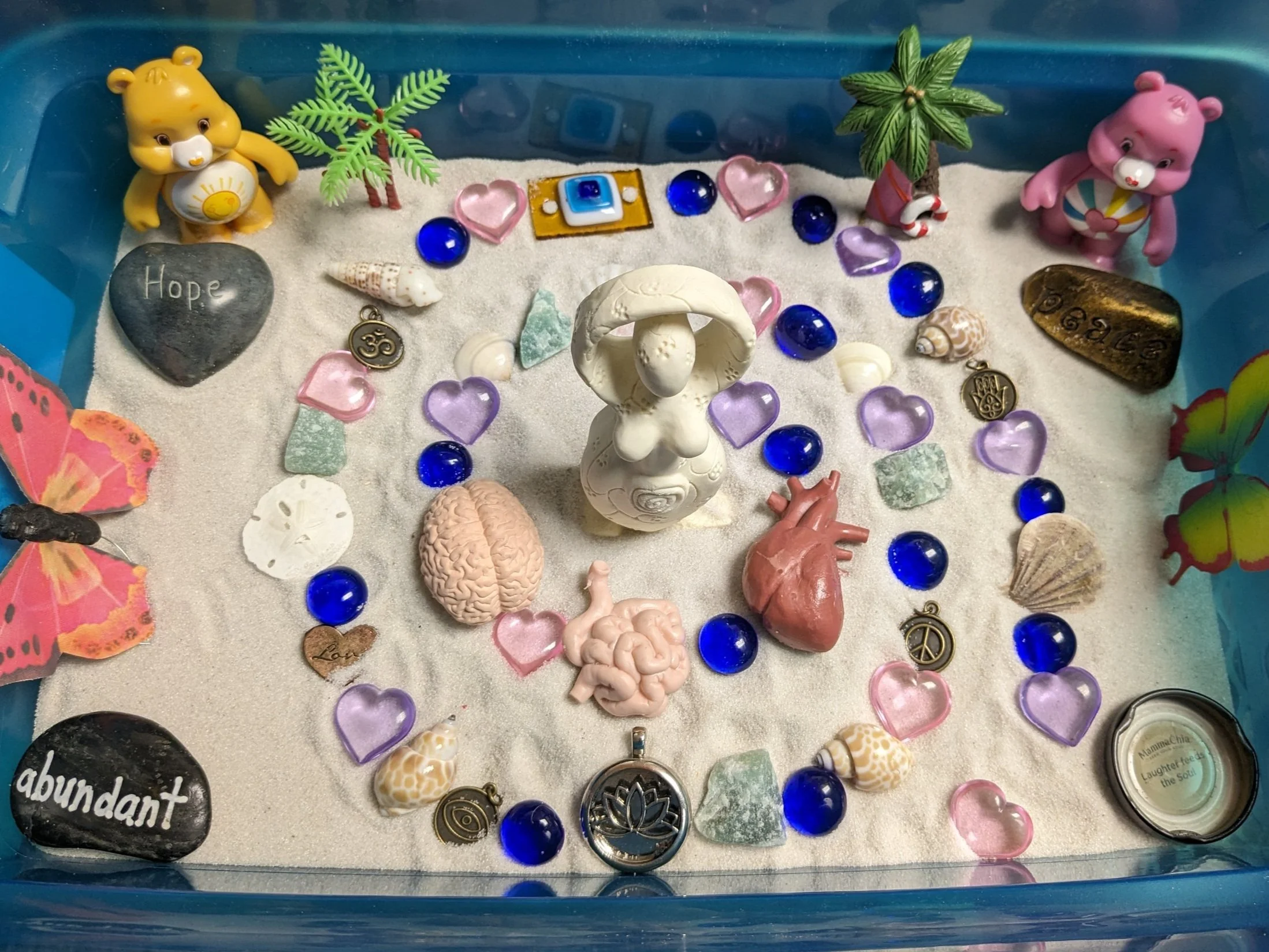
When your mind is racing and you can't find the words or when you're overwhelmed and verbal processing feels impossible, sandtray therapy can help you externalize all of that internal chaos and find words to communicate. You can build, shift, rearrange. You can see it outside of you instead of just spinning in your head.
We explore your hyperfocus strengths alongside your executive function challenges. We work on nervous system regulation, boundary-setting, communication skills, and self-compassion. If you're carrying anxiety or depression alongside your ADHD, we address that too. Sometimes what looks like anxiety is actually ADHD. Sometimes it's both. We work to untangle what's what so you can get the support you actually need.
This is also about finding what works for you, not what works for everyone else. We talk about realistic systems, strategies that stick, and giving yourself grace when your brain doesn't work the way you wish it would.
You're Not Broken.
Your Brain Just Works Differently.
If this resonates with you, whether you're newly diagnosed, exploring ADHD, or wondering if ADHD might explain some of your struggles, let's talk. I offer a free consultation to explore your experience and see if we're a good fit.